Overview
On a public blockchain, anyone can see every balance and every payment an address has ever made. That is a serious problem for a business paying salaries, a freelancer invoicing clients, or anyone who simply does not want their finances public.
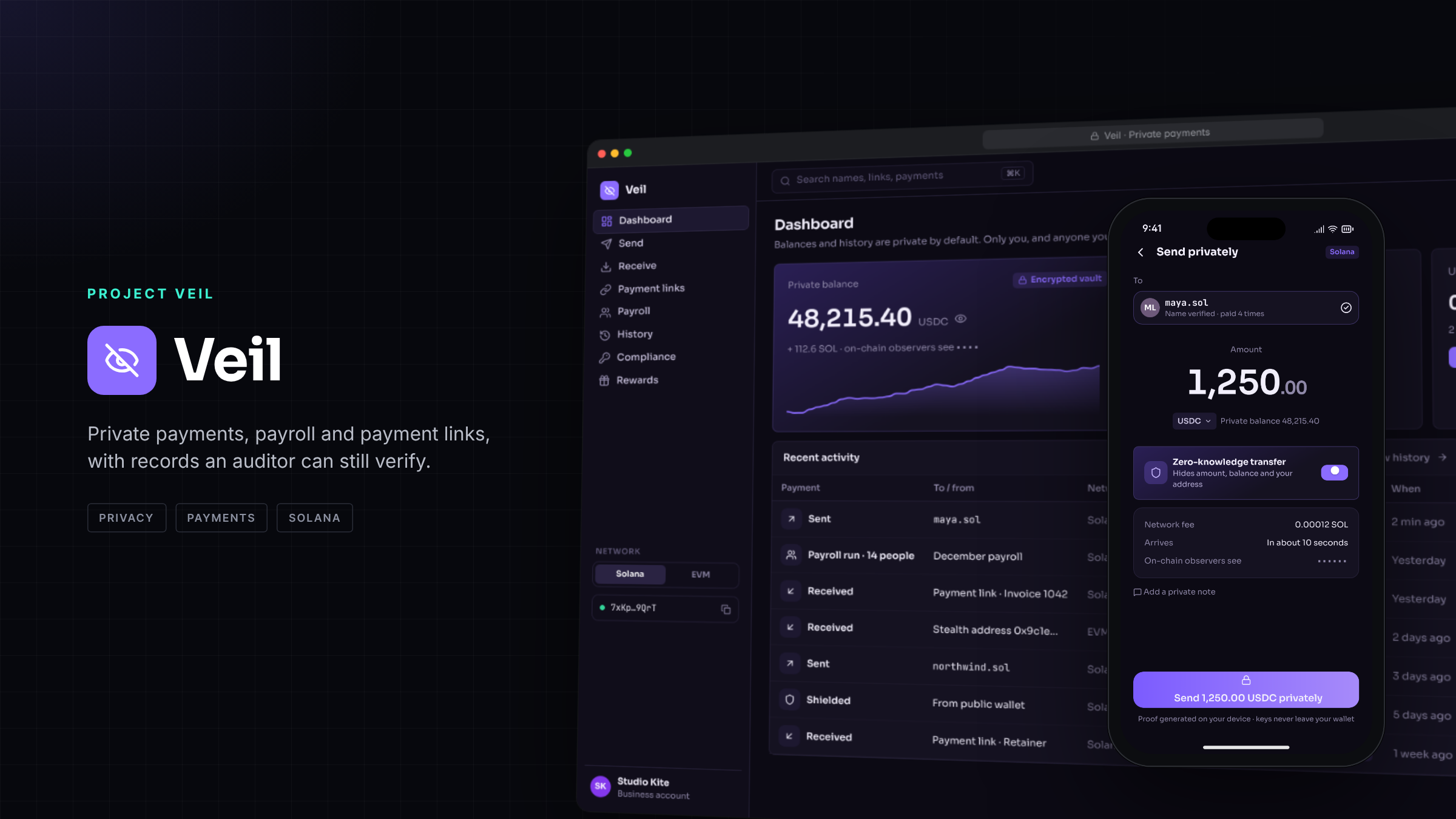
The goal was a payments app that keeps balances and payment history private, keeps users in full control of their own funds, and still lets an accountant or auditor see the records when the owner allows it.
The challenge
- Privacy without custody. Funds had to stay in the user's control at all times; no company holding money on their behalf.
- Simple enough for everyday use. Paying someone had to be as easy as sending to a name or sharing a link, not copying long addresses.
- Business features. Companies needed payroll, not just one-off transfers.
- Accountability. Hiding everything from everyone is not acceptable for a business; auditors need a controlled view.
What Voxen built
Private transfers on Solana.
Funds move into an encrypted vault and are sent using zero-knowledge proofs, so a transfer reveals nothing about the sender's balance or the amount. The proof systems come from established privacy protocols, integrated into one consumer-grade flow.
Stealth payments on an EVM chain.
A second network is supported using ERC-5564 stealth addresses. Each payment goes to a fresh one-time address that only the recipient can spend from, so nothing on-chain links the payment to them. Recipients publish a stealth meta-address once; senders look it up from the user's ordinary address.
Receiving and claiming.
The app scans on-chain announcements locally with the user's viewing key, finds payments addressed to them, and lets them claim with one click. Nothing about the scan is visible to anyone else.
Pay by name or link.
Users can pay a human-readable name instead of an address, or share a payment link that anyone can pay.
Payroll from a spreadsheet.
A business uploads a CSV of recipients and amounts, reviews the batch, and pays everyone privately in one run.
Viewing keys for compliance.
The owner can give an accountant or auditor a viewing key: read-only access to their records, with no ability to move funds.
One dashboard for both networks.
A single interface shows balances, unclaimed stealth payments and history, with a switch between networks.
Engineering approach
All privacy-sensitive work happens on the user's device: keys never leave the wallet, and scanning for incoming payments is done locally. Analytics and naming services were integrated behind clear boundaries so they never receive private data.
Outcome
The app is live on Solana mainnet, combining several third-party privacy, naming and analytics services into one consumer-grade experience, with stealth payments available on a second network.
What it makes possible
Rewards, deeper compliance tooling and more networks can be added on the same foundation: the privacy layer is shared, and each network plugs in behind the same interface.