Overview
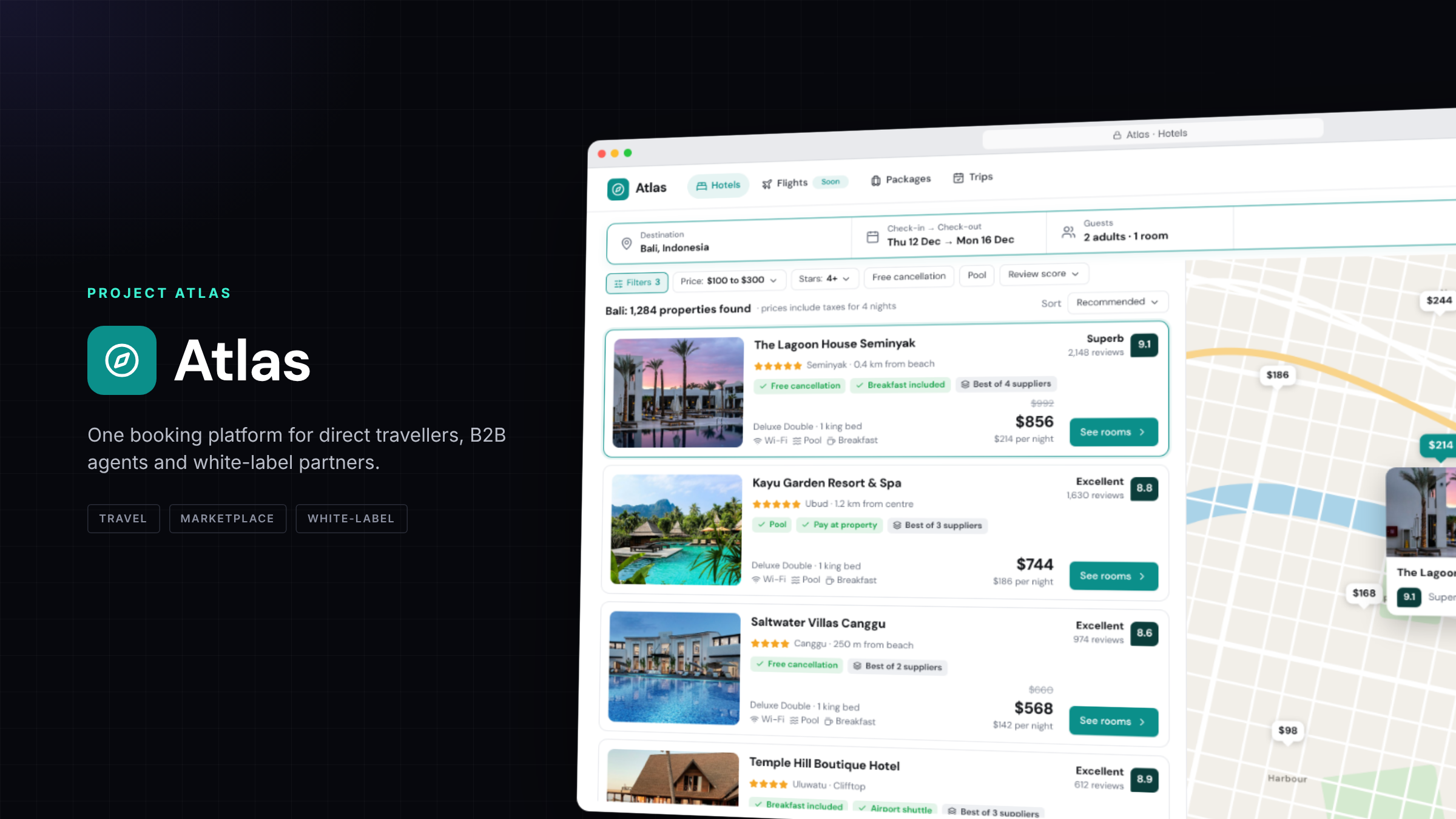
A travel company sold hotel inventory three ways: directly to travellers, to B2B travel agents, and through partner companies selling under their own brands. Each channel and each supplier had been handled separately, so adding a supplier or a partner meant rebuilding the same logic again.
Voxen designed one platform behind all three channels. Hotels came first; flights were planned as the second phase.
The challenge
- Many suppliers, one catalogue. Twelve suppliers describe the same hotel in different ways, with different prices, rules and response times.
- Three channels with different rules. Travellers, agents and white-label partners each see different prices, payment options and permissions.
- Speed under load. Search has to stay fast even when a supplier slows down or fails.
- Partners who need their own platform. A white-label partner expects its own brand, its own domain and its own data.
What Voxen built
A supplier aggregation layer.
Twelve suppliers and the company's own direct inventory sit behind one interface. Each supplier is wrapped in an adapter that translates its data into a common format, so the rest of the platform never deals with supplier differences.
Merged, cached search.
The same hotel from several suppliers is merged into one result, showing the best available offer. Results are cached, and a supplier that slows down or fails is bypassed automatically, so one bad response never breaks a search.
A pricing engine.
Markups are set per channel, per agent and per partner, with currency conversion built in. The same room can be priced differently for a traveller, an agent and a partner's customers without duplicating any inventory.
Agent tools.
Travel agents get wallets they top up and book against, commissions calculated on every booking, and their own booking history.
Payments and notifications.
Card payments run through Stripe. Every booking triggers confirmations by email, SMS and WhatsApp.
Fully provisioned white-label partners.
Each onboarded partner gets its own environment: a dedicated server, its own database, its own subdomain and its own branding. Partners' data is isolated by design, not just by permissions.
An operations panel.
The company's team manages suppliers, markups, agents, partners, bookings, refunds and payments from one place.
Engineering approach
The platform was capacity-planned before it was built: caching, supplier timeouts and fallbacks were designed for peak search load, not added after problems appeared. Provisioning a new partner environment is a repeatable process rather than a manual project.
Outcome
The platform is capacity-planned for 2,000 daily users, 1,500 agents and 150 searches per second. New suppliers plug in within two to three days.
What it makes possible
Flights are designed as the next product on the same foundation: flight search across airlines, booking with a passenger name record (PNR) created through a global distribution system, and ticket management, sold through the same three channels with the same pricing engine.