Overview
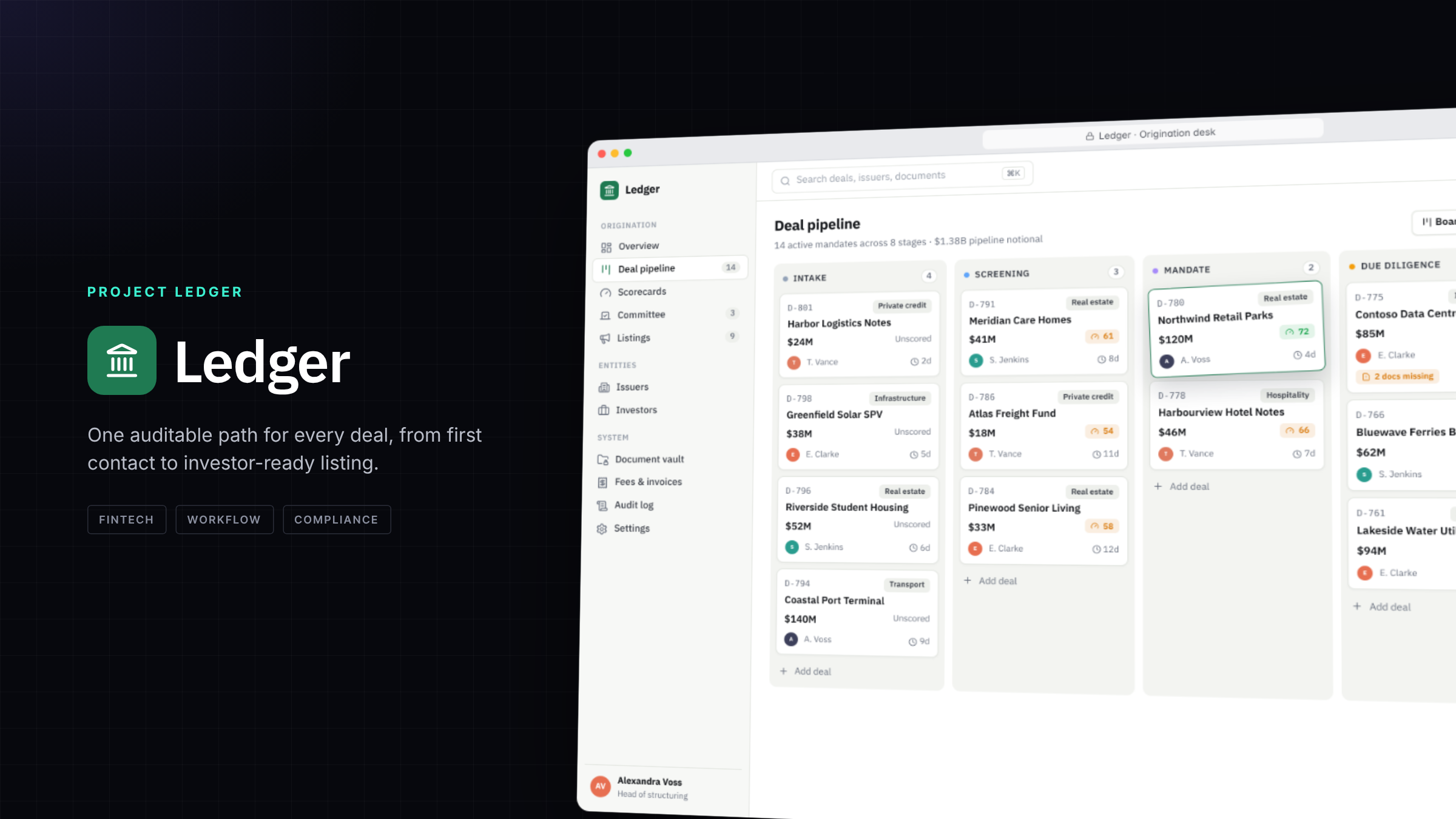
An investment firm that structures private placements sourced and assessed new deals over email. Intake was unstructured, every analyst scored opportunities differently, and when a committee approved a deal there was no reliable record of who decided what, and when.
Voxen built the firm's origination desk: one system that carries every deal from first contact to a live listing, with consistent scoring, a formal approval process and a permanent record of every decision.
The challenge
- One process for every deal. Each opportunity needed to move through the same stages, with nothing skipped and nothing lost in an inbox.
- Objective scoring. Deals had to be scored the same way every time, so they could be compared fairly.
- Provable decisions. Every approval had to show who voted, how, and when.
- Sensitive documents. NDAs, memoranda and due-diligence files needed secure storage with versioning and controlled access.
- Verified investors. Investors could only see opportunities after passing identity checks.
What Voxen built
A stage-gated deal pipeline.
Every deal moves through eight stages: Intake, Screening, Mandate, Due Diligence, SIS Prep (preparing the summary information sheet), Committee, Approved and Live. A deal cannot advance until the current stage is complete. The pipeline shows as a board or a list, and an overview dashboard shows the desk's active deals, the committee queue and average decision quality at a glance.
A weighted scoring engine.
Each deal is scored against ten criteria, such as asset quality, jurisdiction and regulation, management and team, financial metrics and infrastructure. Every criterion has a weight and a score; the engine calculates a weighted total, assigns a risk tier and shows how far the scorecard is from complete. Scorecards are versioned, so every change against the initial assessment is visible, and they export as branded PDF reports.
Committee approvals.
An investment committee votes on each deal in sequence, with a quorum rule. Deals move through pending, in review, conditional, approved and rejected, and every vote is written to a permanent audit trail.
Issuer and investor registries.
Issuers are recorded with their type, jurisdiction and verification status. Investors are recorded with their type, allocation, ticket size and appetite, and they reach their dashboard only after identity verification.
A secure document vault.
Documents are organised by deal and by type: agreements, information memoranda, due diligence, legal and compliance, technical reports and closing binders. Every upload is virus-scanned, versioned and protected by role-based access, with expiry tracking and pending signatures in one view.
Automatic investor packs and listings.
Once a deal is approved, the platform generates its investor information pack and publishes it as a listing, showing valuation, target raise and status.
Fees and payments.
The firm invoices arrangement fees, retainers, advisory and monitoring fees and success commissions from the same system, and tracks what is outstanding or overdue.
Administration.
Team members, roles and permissions, workflow rules, security settings, integrations and the audit log are managed in one settings area.
Engineering approach
Long-running work such as virus scanning, report generation and pack creation runs as background jobs, so the interface stays responsive. Infrastructure is defined in Terraform, so environments are reproducible. The platform was built against OWASP guidance from the start rather than reviewed at the end.
Outcome
The firm now has a fully auditable path from intake to listing. The platform passed a security review against OWASP standards and was delivered across a 16-milestone plan.
What it makes possible
New stages, scoring criteria or committee rules are configuration changes, not rebuilds, so the platform can follow the firm as its process evolves.