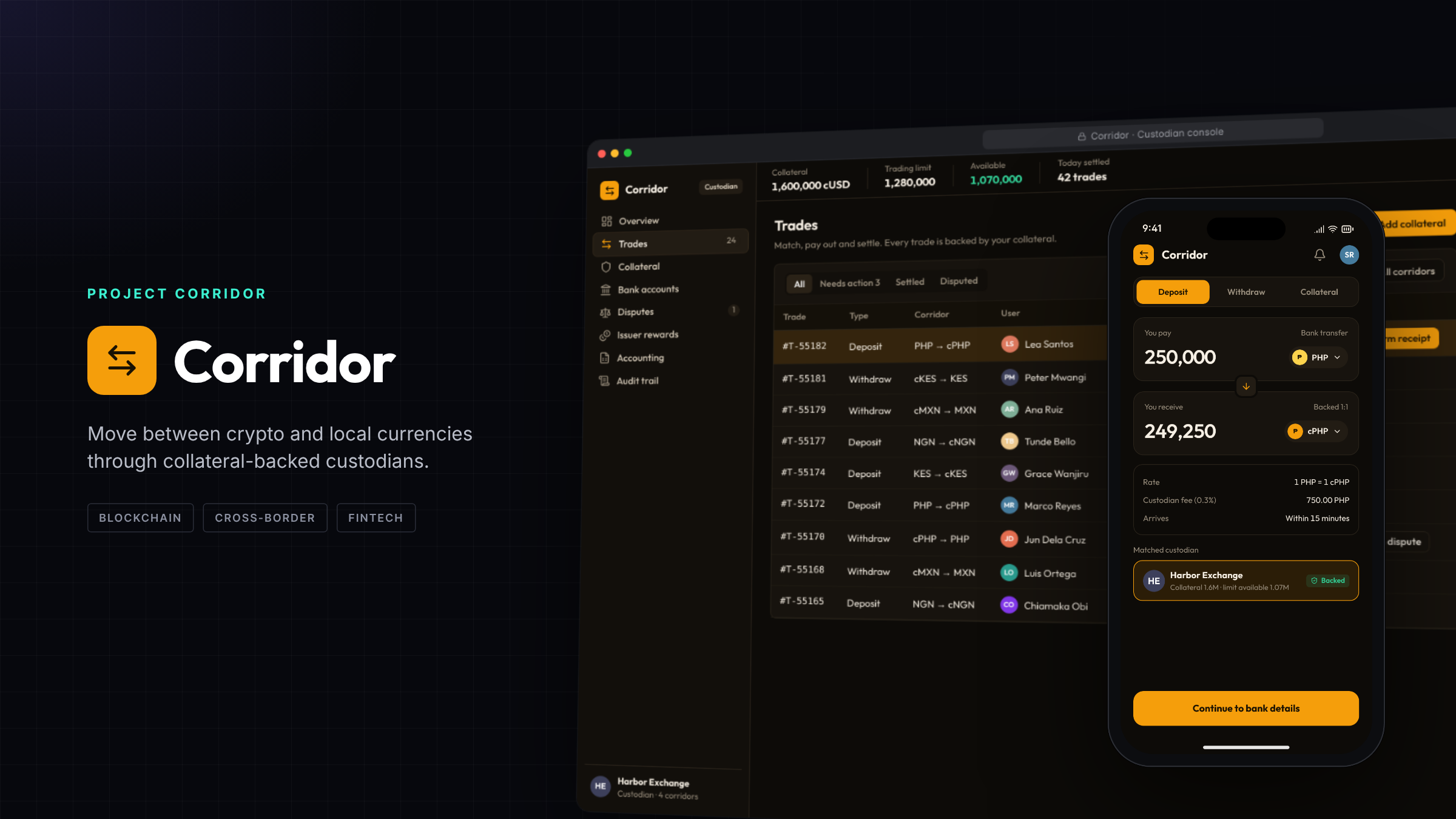
Overview
Moving money between digital assets and local currencies usually means a centralized exchange: one company holds everyone's funds, sets the rates and carries all the risk. The client wanted a different model. People would trade directly with each other on the client's own blockchain, using tokens backed one-to-one by local currencies, with independent custodians handling the bank side of each trade. The exchange would never hold user funds itself.
Voxen turned that model into a working product: the trading application, the infrastructure underneath it, and the economic rules that keep custodians honest and token issuers rewarded.
The challenge
- A chain with no event system. The client's blockchain had no way to emit events and no indexer, so an application could not reliably tell when a deposit landed or a trade settled.
- Safety without custody. If the exchange never holds funds, something else has to guarantee that a custodian delivers the currency they promised.
- Fair rewards. Token issuers earn from transfer fees, and those rewards had to be calculated continuously and accurately across every transfer.
- Records an accountant can trust. Every movement between crypto and local currency had to stand up to financial review.
What Voxen built
Event emission and a dedicated indexer.
Voxen designed a mechanism for the chain to emit structured events and built an indexer that reads them into a queryable store. The application now sees deposits, withdrawals and settlements as they happen, instead of polling and guessing.
Collateral-backed custodians.
Before facilitating any trade, a custodian deposits collateral, and can only facilitate trades up to a fixed share of it. Every trade is backed by more value than it moves, and a custodian who fails to deliver puts their collateral at stake.
Deposit, withdraw and collateral flows.
Users and custodians work from one interface: deposit local currency for tokens, withdraw tokens back to a bank account, and, for custodians, add or remove collateral and see their live trading limit. Fees, rates and the amount received are shown before every confirmation.
Continuous issuer rewards.
An off-chain ledger tracks every transfer and calculates each token issuer's share of fees as it happens. Rewards are paid on a fixed schedule, and every figure traces back to the transfers that produced it.
Dispute oversight.
When a trade is contested, a review process with defined roles examines it and resolves it against the custodian's collateral where needed. Users get recourse without the exchange taking custody.
Accounting-grade records.
Currency conversions follow international accounting practice for foreign-currency transactions, and every action is written to an audit trail, so finance teams can reconcile the platform's activity directly.
Secure real-time trading.
Rates and limits update live over WebSockets, and signing keys live in AWS KMS rather than on application servers.
Engineering approach
The indexer and the off-chain ledger can be rebuilt from chain data at any time, so no record depends on a single database being correct. APIs were tuned for the live trading screens, and the codebase was documented and tested at unit, integration and end-to-end levels before release.
Outcome
The exchange shipped with the infrastructure its underlying chain lacked. Users have a working, collateral-backed route between crypto and local currency, custodians have clear rules and limits, and token issuers are rewarded accurately from real activity.
What it makes possible
New currency pairs and custodians can be added without changing the core rules, and the event and indexing layer serves any future application built on the same chain.