Overview
The client ran a decentralized exchange on an Ethereum Layer 2 with gasless transactions, offering swaps and liquidity provision. Traders wanted the order types they were used to on centralized exchanges, and the protocol needed a way to reward long-term supporters.
The second version of the exchange added an order engine with advanced order types and a staking and governance programme for the protocol's token.
The challenge
- Advanced orders on-chain. Limit, stop-loss, take-profit and time-weighted orders need to wait for the right conditions and then execute safely, without the user watching the screen.
- Best execution. Orders should be filled at the best available price across several sources of liquidity.
- Safety. An order engine that touches user funds must make it impossible to fill at a worse price than agreed or keep funds after a trade.
- Aligning holders. Rewards needed to favour people who commit to the protocol for the long term.
What Voxen built
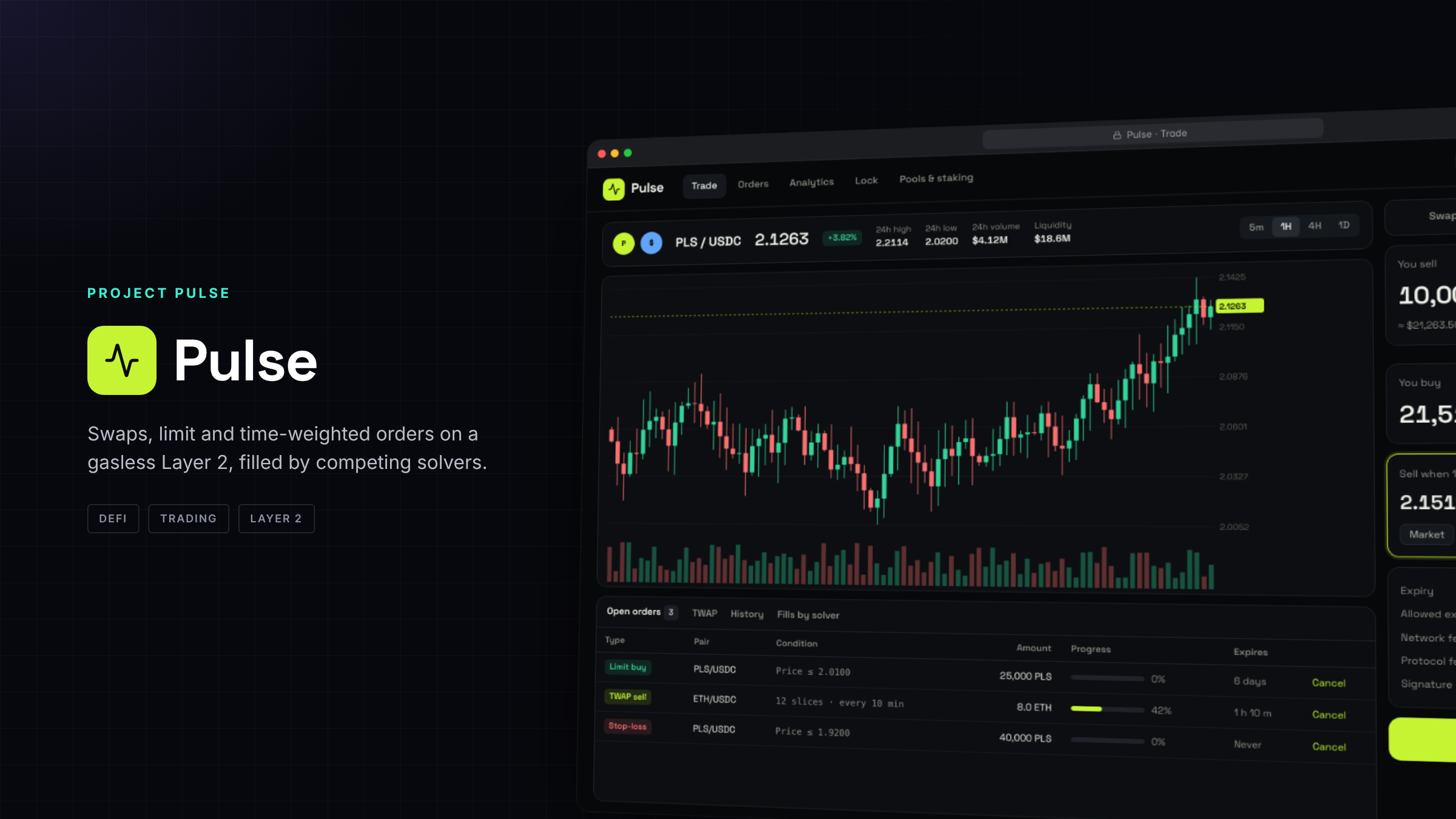
Swap, Limit and TWAP in one interface.
Traders choose between an instant swap, a limit order or a time-weighted order from the same panel. Before confirming they see price impact, expected output, minimum received after slippage and the route taken, with clear warnings when impact is high. Lite and Pro modes, analytics, locking and staking pages complete the app.
Signed orders and an order-matching engine.
Orders are signed off-chain with EIP-712, so placing an order costs nothing, and only the operator can submit them for execution. Users can attach conditions to each order and restrict who may execute it.
Competing solvers.
Orders are filled by facilitators that compete to offer the best price, drawing on several liquid markets and DEX pools.
Time-weighted execution.
Large orders are split into slices executed over time, reducing price impact.
Enforced safety rules.
The system is built around explicit rules that always hold: orders are filled only by the operator, only at the specified price or better, and the vault never retains user funds after a fill. These rules were written as invariant tests and run continuously.
Vote-escrowed staking and governance.
Holders lock the protocol token to receive voting power that decays over time and a weekly share of fees. They vote on emissions and pool additions, and liquidity providers who also stake earn a boost through a time-weighted scoring system. Safeguards limit last-minute changes in voting power and set a minimum participation threshold.
Indexed on-chain data.
The Graph indexes trades, orders and staking activity to power the trading interface and analytics.
Engineering approach
Security was part of development from the start: invariants were defined before features were finished, and testing covered edge cases such as partial fills, expired orders and voting at the end of an epoch.
Outcome
Traders get centralized-exchange order types with on-chain settlement and no gas fees, and the protocol rewards committed holders through transparent, rule-based governance.
What it makes possible
New order types and liquidity sources plug into the same engine and solver network without changing how users trade.